TL;DR: The model string gemini-3.1-ultra really is inside Google’s Antigravity CLI (agy) version 1.3.1, and it was not there in version 1.1.21. But the model is not available to use yet. It doesn’t show up in agy models, and the CLI rejects it if you try to select it. It shows up one week after Google announced Gemini 4 Argon, and it’s the first time “Ultra” has appeared as a Gemini model name since Gemini 1.0.
The claim
A post on X said that gemini-3.1-ultra “just showed up” in the Antigravity CLI 1.3.1 binary and wasn’t in the previous build. The source was a binary audit of google-antigravity/antigravity-cli. Since that GitHub repository holds only documentation, there’s no source code to check. The only way to verify the claim is to look inside the shipped binary. So we did.
How we checked
Our test machine is Windows 11 with Antigravity CLI installed at %LOCALAPPDATA%\agy\bin\agy.exe.
- Before updating:
agy --versionreported 1.1.21. That binary is about 186 MB, built in late August 2026. - Updating: We ran
agy update, which pulled 1.3.1 (about 190 MB). - Extracting model names: On both versions we ran a plain string search for anything shaped like a Gemini model slug:
grep -aoE 'gemini-[0-9][0-9a-z.\-]{2,40}' agy.exe | sort -uCompiled Go binaries store strings back to back with no separators. Some results therefore have unrelated text glued on, like gemini-3.1-pro-highparse. The model names themselves are easy to read.
Finding #1: gemini-3.1-ultra is in 1.3.1, not in 1.1.21
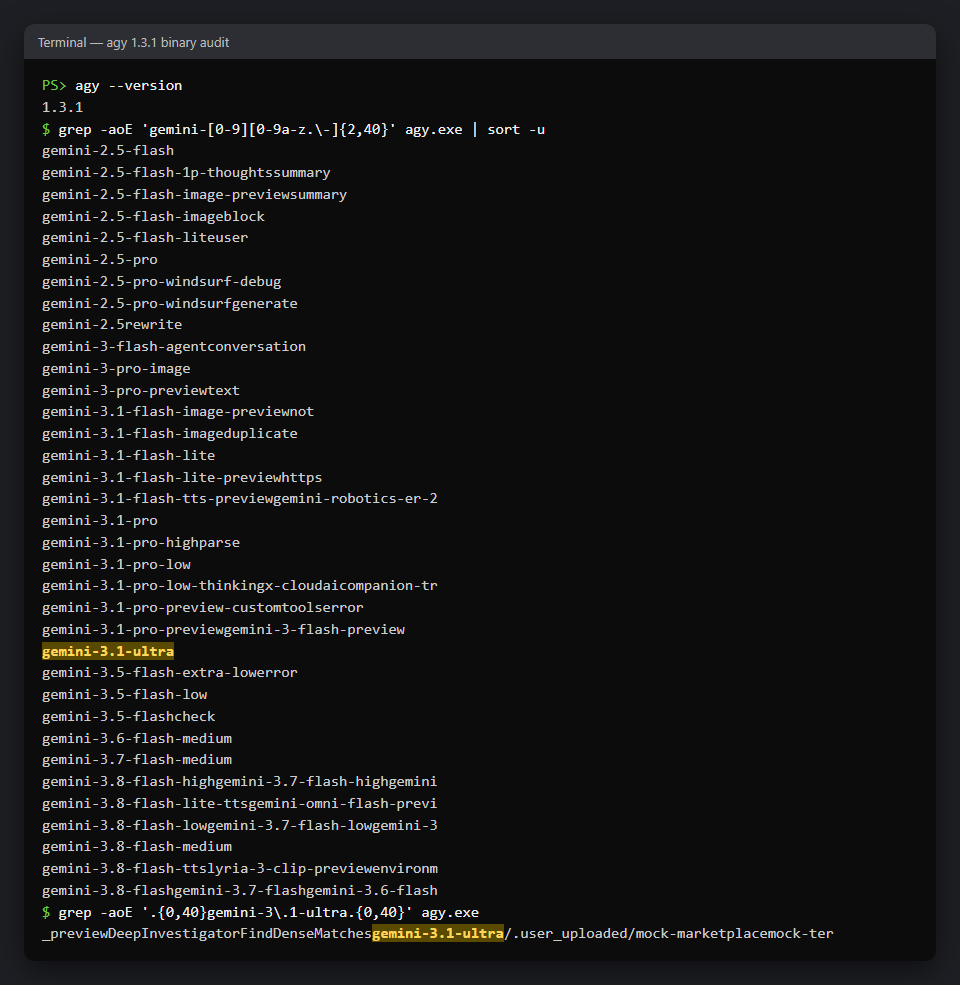
- agy 1.1.21: no
gemini-3.1-ultra, and no Gemini model string with “ultra” in it at all. - agy 1.3.1:
gemini-3.1-ultrais present. Here is the surrounding raw data:
...DeepInvestigatorFindDenseMatchesgemini-3.1-ultra/.user_uploaded/mock-marketplace...So the X post is accurate on the core fact: the string is new in this build.
One detail stands out. Live models in the binary come with reasoning-effort variants. For example, gemini-3.1-pro has -low, -high and -low-thinking, and gemini-3.8-flash has -low, -medium and -high. gemini-3.1-ultra appears exactly once, with no variants. That fits a name registered ahead of launch rather than a model that is already wired up.
Finding #2: it’s not in agy models
agy models asks Google’s servers which models your account can use. Ultra isn’t among them:
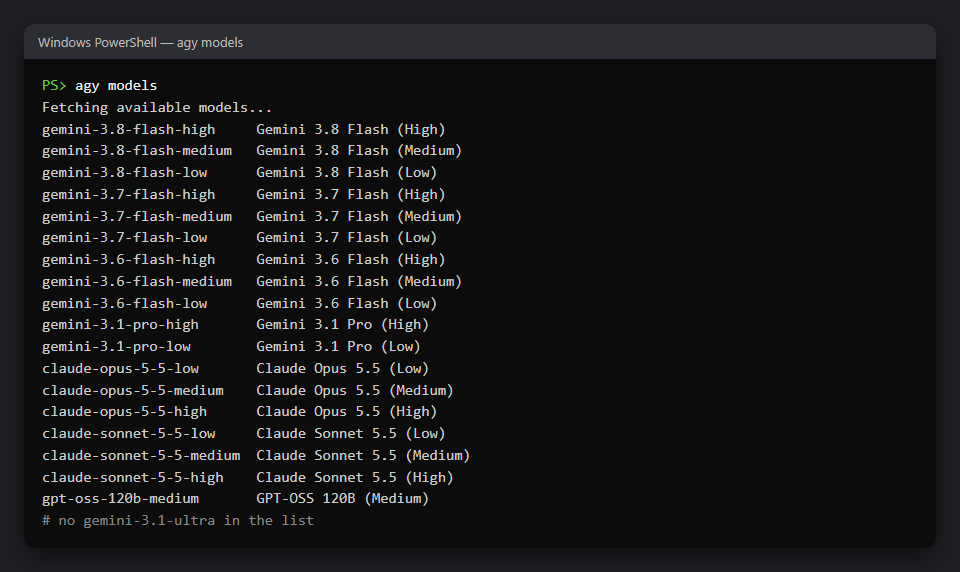
The list has 18 entries: Gemini 3.8, 3.7 and 3.6 Flash (High, Medium and Low each), Gemini 3.1 Pro (High and Low), Claude Opus 5.5 and Claude Sonnet 5.5 (Low, Medium and High each), and GPT-OSS 120B.
Finding #3: you can’t force it with --model
agy --model gemini-3.1-ultra -p "Reply with just: OK"
The CLI stops before it ever sends a request:
model gemini-3.1-ultra is not recognized as a known model or custom model in settings
Adding --effort high or --effort low gives --effort is not supported for model "gemini-3.1-ultra". That looked promising at first. But a made-up name such as gemini-9-fake gets exactly the same error, so it tells us nothing.
Bottom line: the name is in the binary, but nothing is switched on yet.
Bonus: other new model strings in 1.3.1
Comparing 1.1.21 with 1.3.1 shows more than Ultra. These model strings are new in 1.3.1:
| String | Status for our account |
|---|---|
gemini-3.8-flash (-low, -medium, -high) |
Live, listed in agy models |
gemini-3.8-flash-lite-tts, gemini-3.8-flash-tts |
Not listed |
gemini-3.1-flash-tts-preview |
Not listed |
gemini-robotics-er-2 |
Not listed |
gemini-omni-flash-previ… (cut off in the binary) |
Not listed |
lyria-3-clip-preview |
Not listed |
gemini-3.1-ultra |
Not listed, rejected by --model |
The official 1.3.1 changelog (agy changelog) lists only UI fixes and bug fixes. It mentions none of these models.
Why “Ultra” matters: a short history
- December 2023: Google announced Gemini 1.0 in three sizes: Nano, Pro and Ultra. Ultra was the top model.
- February 2024: Bard became Gemini, and the paid Gemini Advanced tier launched on Gemini 1.0 Ultra. The same month, Gemini 1.5 Pro arrived and largely matched 1.0 Ultra.
- From then on: no Gemini 1.5 Ultra was ever released. Through Gemini 2.0, 2.5 and 3.x, Pro has been the flagship name.
- The catch: since 2025 “Ultra” has also been the name of Google’s top subscription, Google AI Ultra. An “ultra” string in code could therefore refer to the plan rather than a model. But
gemini-3.1-ultrauses exactly the format of model names likegemini-3.1-pro, which makes the plan explanation less likely.
So the X post’s history is right: if gemini-3.1-ultra is a model, it would be the first Gemini model called Ultra since 1.0.
The Argon connection
On September 30, 2026, Google announced Gemini 4 Argon, its new top-tier frontier model and, per coverage, “its first flagship model release since February.” Reported details:
- Google positions it against OpenAI’s and Anthropic’s frontier models on coding, enterprise work and cybersecurity. It claims leading scores on some benchmarks and trails on others.
- Access is limited for now: it goes first to vetted cyber-defense partners and Google’s own teams, and Google is taking part in the US government’s voluntary pre-release testing program.
- Next in line: paid API customers and Google AI Ultra subscribers. No public release date has been announced.
- Reported introductory pricing is $2 per million input tokens and $10 per million output tokens, with output of up to 1M tokens per trajectory.
So what is Gemini 3.1 Ultra? (speculation, clearly labeled)
We don’t know, and Google hasn’t said anything. Possibilities that fit the evidence:
- A larger 3.1-generation model placed above Gemini 3.1 Pro, maybe a distilled or cheaper option alongside Argon.
- An internal or pre-release name tied to the Argon rollout, for example to route Google AI Ultra subscribers who get early access.
- A placeholder that never ships. Unreleased names in client binaries are common, and many never launch.
The pattern from past launches is consistent. A name shows up in a client binary first, then in the server-side model list, then in an announcement. Ultra has reached step one. If it goes live, it should appear in agy models without another CLI update.
How to check it yourself
agy update
agy --version
grep -aoE 'gemini-[0-9][0-9a-z.\-]{2,40}' "$(command -v agy)" | sort -u | grep -i ultra
agy models | grep -i ultra
On Windows, run the grep lines from Git Bash or WSL and point them at %LOCALAPPDATA%\agy\bin\agy.exe.
FAQ
Is Gemini 3.1 Ultra released?
No. As of October 8, 2026, it is only a string inside Antigravity CLI 1.3.1. It is not returned by agy models and can’t be selected.
Which Antigravity CLI version contains gemini-3.1-ultra?
Version 1.3.1. Version 1.1.21 does not contain it.
Is Gemini 3.1 Ultra the same as Gemini 4 Argon?
Nothing public links them. Argon is officially branded Gemini 4. A “3.1” name points to a different generation.
Can I use Gemini Ultra with a Google AI Ultra subscription?
Not this model, at least not yet. Google AI Ultra is a subscription plan. Google says Ultra subscribers will be among the first to get broader Argon access.
Was there a Gemini Ultra before?
Yes. Gemini 1.0 Ultra (announced December 2023) was Google’s top model and powered Gemini Advanced at launch in February 2024. No Ultra model has shipped since.
Sources
- Google unveils Gemini 4 Argon, its first flagship AI model since February — Yahoo Finance UK (Proactive)
- Google debuts Gemini 4 Argon, its latest frontier model — Yahoo Finance
- Google announces Argon AI model — The Manila Times
- An important update: Transitioning Gemini CLI to Antigravity CLI — Google Developers Blog
- Google Antigravity plans
- Our own tests: Antigravity CLI 1.1.21 and 1.3.1 on Windows 11, October 8, 2026.